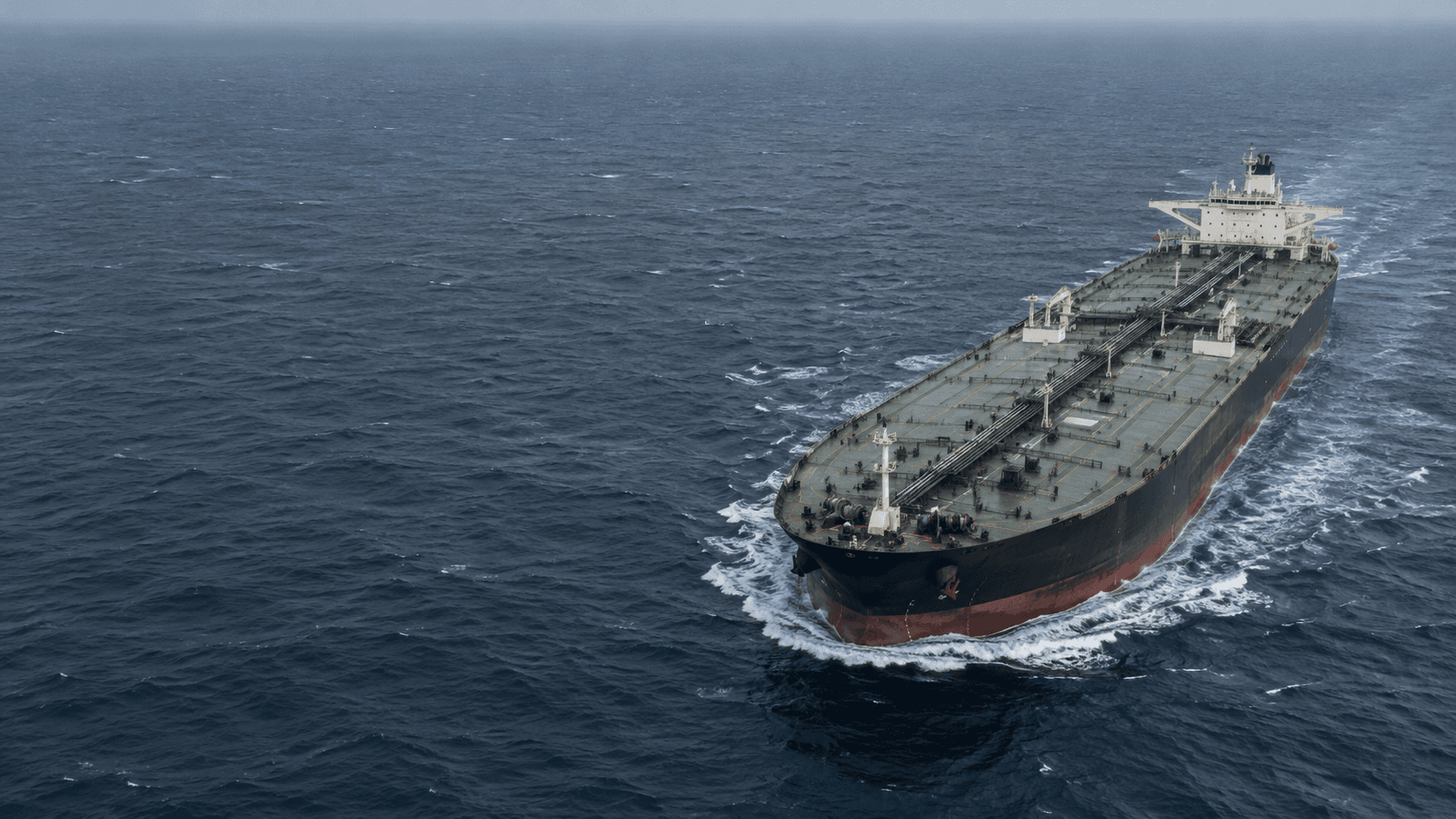
A barrel can be produced, loaded and sold while becoming materially more expensive to deliver. That is why tanker freight has moved from a logistics footnote to a market variable: it links maritime security, routing, insurance, crude differentials, refinery economics and the fuel price paid at the end of the chain.
01 / Market frame
A benchmark barrel is not the same as a delivered barrel
Crude oil is often discussed as if supply ends at the loading terminal. It does not. A buyer needs a viable route, an available vessel, insurance, financing, port access, refinery capacity and a predictable delivery schedule. When any one of those links becomes more expensive or uncertain, the landed cost of crude can rise even if the headline benchmark looks calmer.
The U.S. Energy Information Administration's October outlook makes that mechanism explicit. It describes heightened tanker risk, higher insurance costs, longer routes around conflict areas and tighter vessel availability as sources of pressure on delivered crude costs. The point is not that every cargo pays the same surcharge. It is that logistics can change which barrels are economical, dependable and attractive to a given refinery.
That distinction matters whenever traders draw a simple conclusion from a recovering export count. More shipments are useful evidence. They are not, on their own, proof that the transport system has regained normal resilience.
02 / Evidence boundary
What the recent freight evidence supports, and what it does not
The discussion began with a Goldman Sachs Commodities Research deck shared in a social-media thread. Reuters reported on 21 October that Goldman estimated global average crude freight above $20 per barrel, versus about $3 a year earlier, while costs on Middle East routes were above $35. Reuters also reported Goldman's view that Hormuz crossing risk and ship-to-ship transfers explained more than half of the year-on-year increase.
Those are Goldman estimates, not a public Aeora rate series. The underlying voyage data, modelling choices and route-specific contract terms are not fully observable in the supplied material. We therefore treat the figures as attributed context, not as a universal freight bill for every producer, cargo or refinery.
The broader mechanism is independently supported. EIA expects bypass routes and ship-to-ship transfers to help Middle East flows continue, while acknowledging that such workarounds can leave costs and volatility elevated. UK Maritime Trade Operations incident notices also show that security risk around the relevant waterways is an operational condition, not merely a theoretical tail risk.
The benchmark barrel is only the first cost. The delivered barrel includes the route, vessel, security and conversion chain behind it.
- 01
Security and route risk
Incident risk, transit restrictions and insurance decisions change which routes are viable.
- 02
Voyage mechanics
Rerouting, ship-to-ship transfers, delays and scarce vessels change the cost and timing of transport.
- 03
Delivered crude
The same benchmark barrel can reach different refiners with very different landed costs and reliability.
- 04
Refinery and fuel market
Margins, crude differentials and diesel or jet-fuel availability can react before the headline benchmark does.
03 / Market transmission
Why refiners and fuel markets can feel the pressure first
Freight does not affect every participant equally. A refiner supplied by domestic or short-haul crude generally has more alternatives than one dependent on long-haul imports. The same is true after refining: a refinery may remain operational while crude inputs, bunker fuel, product exports or replacement cargoes all become harder to move.
The International Energy Agency's October Oil Market Report said record freight and crude costs had compressed margins in Europe and Asia. It also warned that freight tension could raise delivered diesel prices in major importing markets if the pressure spread through more tanker categories. This is why a freight shock should be viewed as a delivered-energy problem, not simply an outright crude-supply story.
Inference: higher freight can widen regional and grade differentials, while refining margins and product availability react differently from outright Brent. A lower-risk nearby grade may become more valuable to a refinery than a cheaper cargo that is slower, harder to insure or exposed to an uncertain passage.
04 / Assessment
The useful insight is structural, not a price target
The source deck is most useful when it treats freight as part of the physical oil market rather than a secondary statistic. Security risk has a cost before a cargo is lost. Rerouting, insurance and vessel availability can constrain effective supply. Ship-to-ship transfers can keep barrels moving while making the system slower and more complex. Refined products and refiner margins can react differently from the flat crude price.
Its precise route spreads, contribution waterfall, fleet shares and margin charts should not be read with the same confidence as publicly audited data. Freight is heterogeneous by vessel class, origin, destination, cargo quality, contract structure, insurance cover, waiting time and whether a voyage is actually executable. A tidy freight number can be useful context without being a universal rule.
Aeora's earlier research on Gulf export recovery and resilience risk reached a related conclusion: visible flow normalisation and a resilient energy system are not the same thing. Freight is one of the channels that separates them.
05 / Scenario map
Three transport regimes matter more than a single oil call
Reliability returns before capacity changes
Fewer verified maritime incidents, predictable Hormuz transits, easing insurance stress and less reliance on workaround routes would make delivered costs less fragile. The confirming evidence would be a sustained improvement in route reliability rather than one reassuring export headline.
Barrels move, but the system remains expensive
This is the middle case: crude flows continue while rerouting, vessel risk and insurance costs remain high. A severe physical shortage may be avoided, yet refinery margins, imported-product costs and geographic differentials can remain under pressure.
Freight, prompt supply and products reprice together
Additional verified attacks, a new infrastructure outage, a material loss of tanker availability or a worsening inventory draw could increase stress across the delivery chain. This is a risk scenario, not an Aeora price forecast or trade recommendation.
06 / Monitor list
What to watch next
- UKMTO incident notices and whether reports are verified, investigated or resolved
- EIA updates on Middle East flows, shut-ins, inventory draws and forecast assumptions
- IEA commentary on refinery runs, product availability and margin pressure
- Evidence of normal route restoration versus continued reliance on ship-to-ship transfers
- Changes in delivered crude and product costs, rather than only the flat Brent headline
- Whether a geopolitical headline has altered cargo flows, refinery operations or available inventory
Aeora Research take
Freight is the transmission channel between security risk and fuel risk.
The disciplined conclusion is not that freight dictates one direction for oil. It is that the benchmark barrel and the delivered barrel are different instruments. When the delivery chain is impaired, a calm export headline does not automatically mean that crude, refinery and fuel-market resilience has returned.
This research is for general informational and educational purposes only. It is not investment advice, a recommendation, a trade signal or a guarantee of performance. Market conditions and source estimates can change as new information becomes available.